Tuesday, September 27, 2011

What happens when you decide to race a triathlon the week of the triathlon

Last weekend I was looking through websites to see what triathlon races were coming up since I knew that the season, at least in the northeast, was ending soon. There were two races the next weekend and that was it. There I was with a week to decide if I wanted to race the next weekend. 

Let me take it back to what had happened in the 5 weeks since my last triathlon. I hadn't been swimming at all for a month afterwards. I had crashed on my mountain bike in Vail and banged up my knee pretty bad, not to mention my shoulder and hand sustained some injuries. I had been running long runs on Wednesday and doing speed work on Thursdays with my schools marathon team, I had not been focusing on 5ks off of the bike. Plus I had been been travelling like crazy through Dallas, Colorado and back to Boston then a trip down to DC.

Basically I wasn’t really thinking about racing very much in those five weeks, until I realized that I only had this one weekend of races if I wanted to squeeze in one more. I ate extra clean, got back in the pool, went to spin class and continued running but I had an incredibly busy week so I couldn’t devote that much time to training. I decided then and there that I wouldn’t try to PR or anything, I just wanted to prove to myself that I am maintaining good enough shape to be able to just go run a triathlon on a whim. And that is exactly what I did.

I dragged two friends with me to watch (and be there in case I crashed and I needed someone to drive my car back) and we left for Newport at 5am. Newport, Rhode Island was beautiful even with bad weather and an eerie fog over the water and roads. I registered on site and there were two transition areas so I was a little rushed before the 7:30am start but I made it to the start and organized all my transition gear in time.

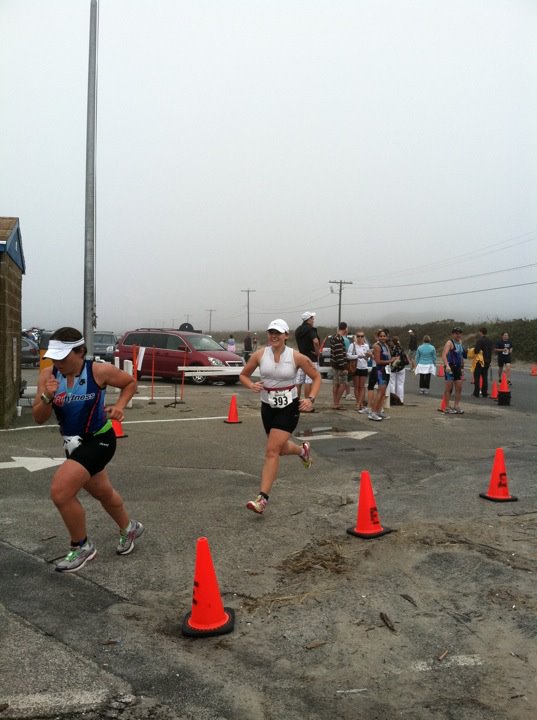
The water was cold even with a wetsuit but fairly calm since the rain decided to stop before the race. I wasn’t quite ready for the saltiness of it after swimming in lakes and rivers and pools. But soon I was in the water, swimming, at the turnaround buoy then stepping carefully over rocks to make my way out of the water. The bike ride was beautiful. 16.1 miles along coastlines and old historic homes. A few big hills but I just tried to enjoy it as much as I could. I rolled into the transition to see my friends cheering, changed into my crazy colored shoes and a hat to keep the mist out of my face and started running. My legs were in pain. I had only given them one day to recover from a hard track workout and it wasn’t enough. I was running at a snail’s pace. But it didn’t matter, I didn’t stop, I kept going and made it over the big hill knowing I just had to run down it on the route back. Way off my 5k pace, I got enough in my legs to sprint through the finish line with a smile.

So there you have it. That is what happens when you decide to race a triathlon the week of the triathlon!


Sunday, August 14, 2011

Amica 19.7 Triathlon

I now consider myself a bit of an experienced triathlete! Yesterday I competed in the Amica 19.7 sprint triathlon in Myles Standish State Forest in southern Massachusetts, a .5 mile swim, 16.1 mile bike and 3.1 mile run! I came in 4th in my age division, so I missed out on a prize by less than 3 minutes. I'll talk a little about the couple of weeks leading up to the race and then my race experience.


I was in an interesting situation the two weeks leading up to the race because my sublease in DC was up at the end of July but my internship went until August 5th. Basically that meant I was living out of my car, my office, my gym and wonderful friends who would house me - not ideal for training! Then the weekend before the race I went on a road trip to Asheville, NC with a friend and went to a vegetarian festival plus I got some hiking and biking in the Blue Ridge Mountains. The way I sort of designed my training program, that week and weekend were supposed to be my most training intensive, followed by an easier taper week down to the race. Instead I was forced to work a little harder than I wanted to the week running up to the race, plus I was driving from DC up to Boston. I had an utterly amazing last week in DC that I wouldn't trade for anything, but it did kind of mess with training!


Details of the race:

I went out way too fast on the swim and had to slow way down before I could find my rhythm again. The pond was calm and warm (I didn't wear a wetsuit) but the sun was super bright right over the exit for the swim so it was difficult to spot where I was going looking straight into the sun. I may have wasted some energy and time not really going in a straight line but overall it was fine.

The bike was on rolling hills which made it both difficult and my kind of race because I happen to like hills and can generally blow past people on the climbs - I have more trouble holding my pace on the flats. It was 16.1 miles and I kept above 17 mph on average which is what I wanted to do.

The run was hard. I don't know if its because I haven't been sleeping that well but my legs didn't feel super rested to start the day and off the bike they were obviously extremely tired. And it was also rolling hills which is much more fun on a bike that on the run. I think I ended up negative splitting but not enough to make much of a time difference. 

Compared to the DC tri earlier this summer I was a few minutes slower; that course had a longer run and this one had a longer bike so they kind of even out, although I would say this was a tougher course.


I now have more crazy traveling ahead of me in my schedule, Dallas then Vail then back to Boston and I'm doing the Massachusetts Spartan Race (5k obstacle course) with some friends when I am back but I have a few days of rest and a birthday this coming week! So for now I will kick back, drink some of the craft beer I brought back from Asheville and eat what I want for a few days!


This summer has been amazing and I have had so many incredible experiences from my internship in DC to training and competing in triathlons and I can't wait for what this fall holds in store for me!


Wednesday, July 27, 2011

Why healthy living is revolutionary


Recently, and I may have posted the link, I stumbled across a website with "100 Revolutionary Acts" towards better health. At first I thought that the website was awesome, a great idea and resource, but then I started thinking about it... why is being healthy a 'revolutionary' act?
(Revolutionary meaning characterized by a marked or sudden change or a break away from the status quo)

Some recent observations:

- I saw this sign in the DC Metro for 7-11 that pictures a Big Gulp full of a sugar filled drink, what looks like chicken or hot wings, and a brownie, with a tagline that says "budget your time, not your taste." Is that what many people think a normal meal or a late night snack should be? Is that kind of processed, sugary and fatty 'cheap' food really people's 'taste'? Is having a different taste 'revolutionary'?

- The line for the metro elevator is always full when the escalators are out... when escalators don't work they become stairs, is taking the stairs 'revolutionary'?  

- Colorado is the healthiest state when it comes to obesity, but it still has over 19% of its adults qualified as obese! (This does not include adults considered overweight.) Why is a state with slightly less than 1 in 5 obese adults the best obesity rate in the country?

- Working for a reknowned cancer organization I see the strong correlation between the spread of the 'western diet' (and with it obesity) and cancer (and othe non-communicable diseases like heart disease and diabetes) throughout the world! Why is a break away from the 'western diet' revolutionary?

When did healthy food and healthy living become a revolutionary concept?

Let me just throw this out there- The high carb, high protein 'western diet' has led to high obesity rates, high cancer rates, high diabetes rates, high heart disease rates, and the spread of this diet is increasing all of those rates worldwide! These rates are the reason that people who are disease free are considered 'revolutionary'! Yes, I just stated that people who are 'disease-free' could be considered healthy because that is what the norm has become. What healthy should mean is fit, energetic, and leading healthy lifestyles and therefore at a low risk for all of those diseases.

I very often get comments from people saying "You are soooo healthy!" or "I could never be vegetarian, I don't know how you do it!" Yes, training for triathlons is a little extreme and not something everyone does or can do because of the time commitment, their current fitness levels, not to mention they might just not want to, but when did my eating vegetables become a fascination for people? Eating vegetables should be normal, not something that sets me apart. Another question I get all of the time: "But where do you get your protein?"

We have been led to believe for a number of years that we need far more protein than we actually do, and this has been helped along by special low-carb diets like Atkins and Southbeach. The CDC recommends 46 grams of protein each day for women ages 19-17+ and 56 grams a day for men ages 19-70+; most cuts of beef provide 7 grams of protein per ounce, meaning that your favorite steak place's 8 ounce filet is as much or more protein than you need in an entire day! Add to that the chicken or turkey you had with your lunch, the cheese on that sandwich, the yogurt with breakfast, not to mention that whole grains and vegetables (if you are eating them of course) also have protein in them, and you get far more protein than you need for the day. You don't need high protein foods or dairy with every meal, for instance protein is used to repair muscle tissue so its best to have it after a workout, you don't need it to fuel before a workout. Too much protein can be converted to fat in your body the same way that excess carbs can be converted to fat in your body. Another misunderstanding we have is portion size - food labels and nutritional information that is given out in grams and ounces is useless if we don't know what a gram or ounce of that food actually looks like.

I am going to make this as simplified as I can- look at a plate. 1/2 should be non-starchy vegetables and some of it fruit, 1/4 should be dairy/lean protein, and 1/4 should be whole grains or startchier vegetables. If you can make your plate look like this every meal you will for sure be getting enough protein, healthy carbs, and most of the nutrients that your body needs - fiber, antioxidants, vitamins, minerals.

Are you an endurance athlete? - make it more like 1/3 whole grains. Trying to add muscle? - make it more like 1/3 dairy/protein. Trying to lose weight? - make it a smaller plate. This basic model can be changed to fit your needs, the USDA just released a 'my plate' feature but it still categorizes corn and potatoes as vegetables and  dairy as a separate category. Active.com wrote a good piece on it that outlines a better way to look at the plate, more along the lines of how I picture it.

Does every single one of my plates look like this? No. Do most of them? Yes. Especially when looking at the entirety of my meals over the day. I prefer whole grain heavy in the mornings - oatmeal or cereal with fruit and supplements like maca, raw cacao and hemp; green leafy vegetable at lunch like a salad; one snack of raw almonds, a different snack of fruit with yogurt; and some combination of vegetables, beans, lentils, tofu, quinoa, etc. cooked for dinner. All of that pretty much evens out to the distributions of my ideal plate.


Is my plate revolutionary? I think many people believe that is what a plate should typically look like, but its not what most people's plates actually look like.

I'm not trying to buck the status quo, I am trying to reestablish it. Healthy living should be the norm, not revolutionary!

Who is with me? Who wants to establish vegetables as a normal part of their diet? Who wants to walk up and down the escalators turned into stairs? Who has a taste different than big gulps and 7 eleven chicken wings? Who thinks obesity, cancer, diabetes and heart disease should not be increasing around the world? If you are with me then I guess you are a revolutionary too!


Tuesday, July 12, 2011

four hour body

I know it has been a while since I posted, I've been a little busy with making the most of being in DC, my internship, and training for the August 13th triathlon! This is a little different that my usual posts - it is a book review of sorts or rather an analysis and synthesis of certain methods to making changes in your body and I am only looking at a small part of the book.

I recently purchased Tim Ferriss's Four Hour Body mainly because I have heard so many controversial things about him and the book and I had a Border's gift card to spend. He used himself as a guinea pig, tracking workouts and nutrition for decades and has identified the smallest changes that he could do to make serious increases in weight loss, muscle gain, strength gain, etc. and also has some evidence on how it worked for other people as well. It's a pretty big volume and covers a lot of different subjects all having to do with the body in some way and making gains with the smallest effort needed. While I don't always agree with that principle in itself - if you want to make a change you should probably put in the 100% effort to make that change happen, not just try to find the easiest way - he does has some really interesting strategies for making new routines stick.

Have a set goal. Mine are the two triathlons this summer, but if you want to lose weight or gain muscle set a weight or body fat percentage goal, or put a number on how much weight you want to lift or how far and fast you can run. The goal though has to be realistic within a certain time frame.

One major strategy for doing this is keeping track of the data and changes without using calories or a scale as measurements. Calories don't help you separate the kinds of foods that will help you lose weight or add muscle, they are just a unit of energy. Calories can be an easy way to track the amount of food you consume, but they shouldn't be relied on as a good indicator of the health of the foods you consume. And a scale only measures weight - not muscle mass. I am five foot four inches and weigh over 130lbs which is at the top of my BMI range - but I am probably around 15% body fat and that muscle is never taken into account on a scale. Circumference of your waist, arms, hips and legs, or a fat caliper are much better measurements to take while tracking changes in your body than your weight alone.

Another strategy is one shared by the Nerd Fitness community and that is to somehow stay accountable for your set goal. Have a support group, make a bet with friends (where you lose money if you don't fulfill it which gives you more incentive than if you were only to gain money you didn't already have once you completed your goal,) take an unflattering before picture and post it somewhere you see it everyday. Even during the process you can take a picture of everything before you eat and post that online - you won't want to post a picture of terrible for you food or a giant bag of candy. Have others involved in the whole process and you will want to prove it to them and they will hold you accountable whether they are encouraging or discouraging you along the way (ignore the discouraging friends or use them as fuel to work harder.)

I can also be a resource - shoot me an email and I can give you just some plain old encouragement, I can plan workouts or a meal program for you, hell if you know me I can work out and/or cook with you! If you tell me what your goal is, I will do my best to help you reach it. Even if your goal is just to add more vegetables to your diet - I can help you out!

In regards to the book, its fun to scan through but I wouldn't go out and buy it right away (borrow my copy first!) I'm obviously a fitness nerd, so I like when he gets into the little experiments and the more scientific jargon and shows exactly what the human body can be pushed to do - but other people may not. I wouldn't use him as a guide to changing your lifestyle, but instead as a reference or resource. Even Ferriss admits that you have to find the formula for change that works for you, and especially the motivation to make the change, his method worked for a number of people but those individuals were all committed to his specific methods.

I think the main point to takeaway is that you have to find your motivation, set your goal and find a way to make yourself accountable to that goal - that is the key to making changes towards a healthier lifestyle!


Monday, June 20, 2011

Officially a triathlete!

I finished the .8k swim, 20k bike and 7.5k run in 1 hour 44 minutes and 10 seconds, good enough for 14th in the 18-24 year old women's age division and in the top 19% of all women competing in the sprint distance. Those results are better than I expected and I am more than pleased with my time!

Let me go into details on the race: The DC Triathlon had over 3200 registered racers for the sprint or international/olympic distances. That is a pretty big race logistically and I have to give a lot of thanks to the race organizers because it was very well run! Saturday I went to pick up my race packet at the expo at the Washington Convention Center and we took our bikes from there over to the transition area for racking via a police escorted bike ride through DC, meaning that we got to run a bunch of red lights and piss off the tourists and motorists! Sunday morning I woke up at 3:45am (when some of my housemates were getting home) and drove to the parking lot at the expo center to take the athlete's shuttle over to the transition area. Even leaving that early I didn't get to the transition area till 5 or a little after 5am.


I set up a transition station right next to my bike where I put down a plastic bag (because the ground was damp since it was drizzling out), a quick dry towel to stand on when I changed out of my wetsuit, my bike shoes with socks ready to go in them, behind that I put my running shoes with my race belt with bib race number attached and a hat in case I wanted it for the run. On my bike I put my two full water bottles in the cages, taped a larabar onto the top tube so I could grab it while on the bike, used the velcro on my bike gloves to attach them to the handlebars, and placed my helmet on my aero-bars with my sunglasses inside it. This set up worked really well for me because the less you have to worry about during the actual transition, the better. Having a bunch of stuff attached to my bike got me out of the transition area much quicker.

I got my chip timer and attached it to my ankle, and made sure that my body markings (when they write your race number on your legs and arms) was still clearly visible. I used bodyglide (an anti-chafing deoderant-like stick) on my ankles and places the wetsuit would rub so that I could make sure to get it off easily and it wouldn't chafe my neck, arms or legs too much. I then saw a woman who had a message written in pen on her leg - I mean I didn't lean over and read the message, I just saw that it was written there - so I took out my sharpie and wrote a mantra inside my swim cap. It was something that I knew was there but didn't need everyone else to see and because I wrote it down I remembered it and repeated it to myself on the course. By the time I had done all of this it was time for the 6am international distance to begin and we all had to be out of the transition area. I put on my wetsuit, stowed away my gear bag, and chatted a little with some fellow triathletes.

Before I knew it, it was time to get with our age groups and line up to jump into the water in groups of 8 (it wasn't a mass start but instead a time-trial start meaning our chip started to time us as soon as we jumped off the dock.) I don't think I was prepared enough for the jump into the Potomac River because I kind of had this moment when I was a few strokes out into the water from where I jumped were I was like "holy shit, I'm swimming in the Potomac!" I didn't think about the grossness of the water and instead just started a rhythm and tried to avoid and swim around people. I've never really timed myself on an 800 meter swim in the pool nor in open water so I don't know how far I am off of my normal swim times, but I swam this in 14:30 - which I think is pretty good for a newbie, plus I really just started swimming in late April. I'm proud of it whether it's better than average or not!

My wetsuit came off easily in transition, I was soaking wet but somehow got my feet dry enough to slide on my socks and velcro my bike shoes on and run with my bike out of transition. Once I mounted my bike, I flew. Biking is my strongest leg of the triathlon but if I had been able to bike the course before hand I could have shaved off a few minutes by knowing when the uphill and downhill sections were and where their weren't turns and I could have pushed harder on the straightaways. That is the problem with having a bike route in a city that is normally so crowded with cars that you can't recreate the route on your own. It was a very technical course with a lot of turns and u-turns that tested my bike handling skills. I kept an 18-20 mph pace most of the time - unless I let an unexpected uphill section spoil my cadence. I ate a larabar on the bike, but I think I ate it too quickly because I could feel it in my stomach once I started running. What I know for next time is to probably eat half of it within the first three miles of the bike and then the other half towards the end. I made sure to drink almost an entire bottle of water over the 20k course though which was good since sometimes on a ride I forget to drink until I'm already thirsty. I got back to transition and realized I was 2 events down and had only the run to go.

I undid my bike shoes dismounted from the bike and ran it into transition, slipped on my colorful Asics Noosa Tri shoes and pulled the toggle on the no-tie laces. Clipped on my bib and was on my way out. This course was originally going to have a 5k run, or so I believed. Then during my open water race clinic I learned that it had been extended to a 7.5k which I had not been training for. I was overtraining for a 5k but it still had a kind of mental influence on knowing that the run was just a little over a mile longer than I was planning for. So I came up with a different way to approach it. I decided that I would take the first 2.5k to just get my legs back from the bike - then I could just run a 5k once my legs were back. That really helped me mentally to break it down like that. The run was still pretty hard, with some uphill portions, a lot of turns on roads that seemed self defeating, and I was experiencing a little bit of stomach cramping from eating the larabar on the bike. I got water at every aid station but I never stopped or walked, I kept going. It helped that all around me were majestic monuments or DC buildings and there was a light drizzle all morning that actually kind of kept me cooled down. I got to the last section and I still had enough in my legs to sprint to the finish, I smiled and raised my arms up into a strong woman pose! I was now officially a triathlete.

I was handed my finishers medal, a water bottle, powerade and a wet towel. Then I went over to the place where the racing receipts from the chip timers were printed. That was where I saw I had placed 14th in the women's 18-24 year old division and that I had an official time under 1:45:00. I was appropriated exhilarated, exhausted and a little dazed.


I got some food, qdoba naked burritos, ate and found my friends. They got some pictures of me and we stocked up on free Pom juice and sat around and talked for a while and figured out a way for them to get my car from the expo center and meet me to pick me up with my bike and stuff from transition. They're awesome so we got everything handled and with everything picked up we headed to my house where I had beer, wine, chips, salsa and guacamole waiting for us, but not before a pit stop at Shake Shack where they bought me a chocolate milkshake - which was what I had earlier decided I wanted as a reward for this triathlon since I haven't had one in probably more than two years. It tasted well-deserved!

Showering was wonderful, sleep was even better, and now I have a week of training off before I gear back up for the Amica 19.7 Sprint Triathlon in Boston in August!

Wednesday, June 15, 2011

Only a few more days of being a tri-newbie!

Less than five days till my triathlon and I am just slightly freaking out. 

The swim is less of a mental hurdle for me now that I participated in a practice open water swim in the Chesapeake Bay last weekend and felt comfortable in water with a much stronger current than the Potomac will have (although the Potomac will be grosser) and I greatly enjoyed trying out my wetsuit - its amazing how much more buoyant it makes you! The bike is a pretty technical turning course but I trust my bike handling skills and there will be some amazing views of the DC monuments over the course. The run has been extended from a 5k to a 7.5k, which is fine if I was just running that, but after the swim and bike that extra 2.5k might be a mental struggle far more than a physical struggle but some of my friends who are in DC are planning to come out early on a Sunday morning to cheer me on!
 
This week is my taper week, and my taper is probably a little different than others because I still needed to get in one more long distance swim workout because I was behind schedule on the swim, so yesterday I went a little more all out that I was supposed to, racking up more than a mile of swimming in my main set between my warm up and cool down. Sunday was my last long bike ride, Monday was a medium tempo run - so a 5k at race speed. Today, Wednesday is a rest day, tomorrow Thursday will be a brick workout of short run, short bike, short run, Friday 50 yard sprint swims and a core workout, then Saturday a very light jog - just till I break a sweat 10 to 15 minutes. Then Sunday is the triathlon where I'll do some dynamic warming up while I'm waiting for my swim wave to start at 7am. The hardest part of training this week is resisting the desire to over train!
 
Nutrition is another aspect I am planning for this whole week- I'm not introducing any new foods, I am staying totally vegan and cooking all my meals, so no eating out at all, (I plan on my version of pigging out on Sunday after the race!) and no alcohol for the two weeks leading up to the race, (I have a bottle of Malbec to be opened Sunday evening.) Basically I am eating the same few meals over and over again, which people think would be boring but if you think about it most people do that anyway - especially with breakfast. My staple foods are whole grains or psuedograins like buckwheat, quinoa, faro/barley, cracked wheat (in a tabouli salad) and sprouted grain bread; spinach and kale both raw and cooked; sweet potatoes; raw nuts and seeds like almonds, walnuts and sunflower seeds; my superfoods maca, raw cacao and chia; and berries. I will keep eating raw foods until Saturday afternoon when I'll need to take in less fiber prior to the morning race. Tomorrow and Friday I am adding some extra carbs. Every day this week I have had a big kale and/or spinach salad with a garbanzo bean, tomato, cracked wheat/buckwheat tabouli for lunch with some raw almonds or an apple as a snack. Breakfast is my weird version of cereal- puffed rice, puffed kamut or millet, maca, hemp seeds, chia seeds, raw cacao, agave, raw pumpkins seeds, walnuts, rice milk and berries. Dinner is a grain combo of quinoa and faro, with sauteed kale, or a different roasted green vegetable and baked sweet potato. If I am hungry before a workout I have a few dates and almonds or half of a Larabar. Oh yeah, and I have been and will continue drinking water like crazy. I don't know if Sunday will be nice like it has been for the past few days, or like DC usually is during the summer - hot and humid.  
 
Again, for this triathlon my goal is only to finish it and enjoy the spectacle, August is when I'll race for time. If you are around the Washington DC area and want to come out and support me early on a Sunday morning, feel free to do so! I will appreciate it tons!


Friday, June 10, 2011

greetings from DC and the dreaded swim

Now that I am settled into one place (and found housing about four days before moving here) its time for an update. On my week and a half road trip from Dallas to Boston to DC with my mom we stayed in a different city every night, (except for the stopover in Boston where I was at my place) and drove most of the days, but I still worked hard to maintain my triathlon training. I took advantage of hotels with pools, I used running as a way to explore the different cities/places we were staying, met a man in the tiny hampton inn suites who does triathlons and had a nice chat with him while getting in some core strength, tried to bike when possible, and tried out Matt Kamb's hotel room workout. I usually got all of this in before my mother even woke up and it helped when I spent the rest of the day sitting in a car either behind the wheel or in the passenger seat. If this was a travel blog I would talk a little bit more about every place I went but for now I'll just say that Asheville, NC and the Blue Ridge/Smokey mountains are gorgeous and I will be going back there! But since this is about leading an active lifestyle I'll stick with the working out parts of my trip- basically it's possible to travel and still train effectively as long as you make the time and take advantage of the resources around you.

My number one tip: when you get to a new city, walk or run around it for a while - you never know what you may discover, who you'll meet, or what experience you'll have but, you'll probably discover a new store, restaurant, or gorgeous views, meet someone truly interesting, and have a great overall experience!

I have already noted many times that the swim will be the most difficult part of training for these triathlons because it is something I haven't trained for before. Calling it the 'dreaded swim' might be an exaggeration, but I am the most apprehensive about it. But, something clicked in the pool a couple of days ago. I had been doing mainly sets of 200 meters because I have been swimming in 25 meter pools and anything more than that I would just get sick of the repetition or feel like I'd been swimming for way longer than just the few minutes I'd actually been swimming. But the other day I read an article on www.active.com about the habits of the most effective swimmers. One of them was counting strokes. This was such a simple idea and I don't know if I'd read about it and ignored it before for being too simple, but this habit was highly effective for me as soon as I got back in the pool. It gave me a steady rhythm, kept me paced each lap, set a steady bilateral breathing pattern, and before I knew it I'd swam a 400, easy. It was paced, not quite to race speed but not slow either, and I probably should have pushed myself to do more than that in that set but I had many more sets to go. My goal is to be able to do this ladder workout once a week 1x800, 2x400, 4x200 and 8x100, which is almost 2 miles! That's seems crazy for me to even think about, me, someone who really just started swimming for distance in April/May, but now 2 miles seems achievable, a new goal.

Because of all the interruptions and moving around I've done the past month between Boston, Dallas and DC, I will just be ready for my triathlon next weekend and finishing it without injuring myself is my goal. Then I can ramp up again for the August triathlon where I will set a time that I want to finish in, right in time for my 22nd birthday!